
The third quarter of 2025 was very positive for both the stock market and the bond market. Tech leadership won out over tariff fears and the Fed began cutting interest rates due to a weakening labor market. Read on for a deeper dive into how markets performed in the third quarter and what that might mean for your portfolio in the future.
Strong Quarter, BUT IS IT SUSTAINABLE?
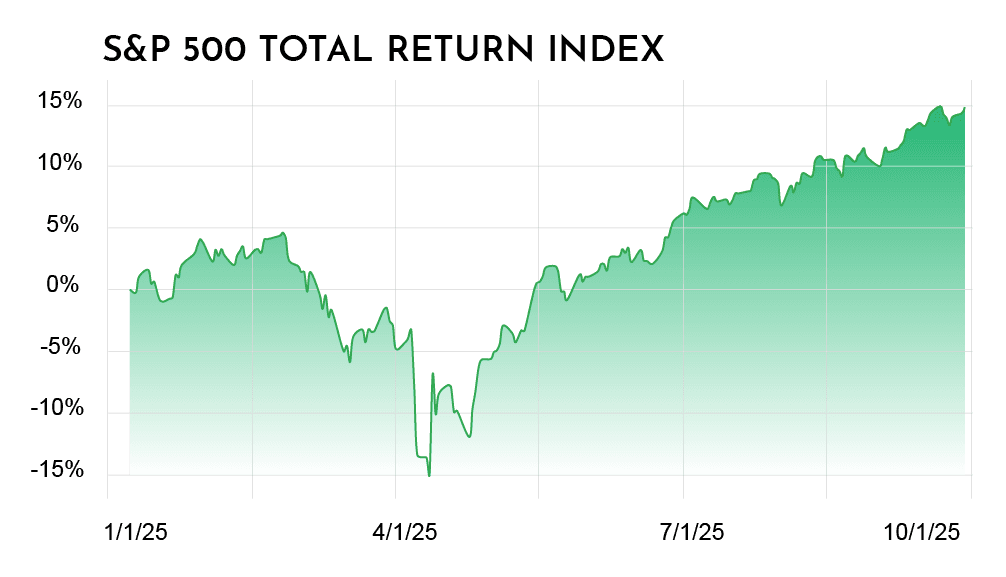
The stock market gained 8.12% in the third quarter1 buoyed by Tech leadership and AI enthusiasm in addition to the Federal Reserve’s first rate cut of the year.2 For the full year, the market is up 14.83%. Since the April low, it’s up a whopping 35%! Somewhat surprisingly, the August implementation of reciprocal tariffs didn’t lead to as much volatility as it had in April. The advance in the market is further stretching valuations, so exercising some caution ahead is warranted.3
THE REASON BEHIND THE INTEREST RATE CUT
Following 1.00% of interest rate cuts at the end of 2024, the Federal Reserve had stayed put for much of 2025 as inflation was cooling but still above its target level. But in September, the Fed cut interest rates by 0.25% partly due to weakening labor conditions as opposed to just a cooling of inflation. The Federal Reserve’s objective is to use monetary policy to support maximum employment and stable prices, and the Committee noted in its statement that job gains have slowed and downside risks to employment had risen. It’s likely the Fed will take a wait-and-see approach without committing to a series of future rate cuts. If inflation reignites and the job market continues to deteriorate, the Fed would be put in a very difficult position.
| Maturity | Yield* |
|---|---|
| 6 Mo | 3.83% |
| 1 Yr | 3.68% |
| 3 Yr | 3.61% |
| 5 Yr | 3.74% |
| 10 Yr | 4.16% |
| 20yr | 4.71% |
Opportunities in Municipal Bonds
The bond market gained 2.03% in the third quarter and is up 4.39% for the year. Within fixed income, municipal bonds present attractive opportunities for tax-sensitive investors due to a surge in issuance. Municipal bonds are exempt from federal income tax and possibly state income tax. Even though municipal bond yields appear lower than treasury bond yields on a pre-tax basis, they may be higher on an after-tax basis especially for investors in higher tax brackets. Recent ratios of AAA municipal bond yields to treasury bond yields are 70% for the 10-year and 91% for the 30-year.5 That means investors in a combined federal and state marginal tax bracket of just 30% could be just as well off or even better in 10-year municipal bonds than taxable bonds. These ratios are higher than historical levels especially for longer maturities.
What’s Next?
Looking ahead, it appears valuations in U.S. equities are no longer cheap and Washington’s ongoing government shutdown adds another headline risk to an already complex backdrop. A constant storyline will be whether the investment in artificial intelligence truly transforms the economy like the gold rush or is merely just a sugar rush.6 Expect choppier paths to returns as some cracks have started to emerge and threaten the prevailing positive trend, but realize that equity exposure generally pays off over the long run. Rest assured, we are watching these developments and balancing the risks and opportunities for long term success.
Sources & Disclosures
1. Data from Kwanti.com based on the S&P 500 Total Return index
2. https://fred.stlouisfed.org/series/DFEDTARU
3. https://fortune.com/2025/09/30/warren-buffett-indicator-surge-markets-economy-what-it-means/
4. https://home.treasury.gov/resource-center/data-chart-center/interest-rates/TextView?type=daily_treasury_yield_curve&field_tdr_date_value_month=202509
5. https://www.nuveen.com/en-us/insights/municipal-bond-investing/municipal-market-update
6. Andrew Ross Sorkin’s interview on 60 Minutes (10/12/25) [transcript]