
The stock market displayed broad growth in 2025 with a 17.88% return despite the uncertainty surrounding numerous changes to domestic policy. The bond market gained 7.3% due in part to the Fed lowering interest rates in response to cooling inflation and to support a slowing labor market. While we are optimistic about 2026, we continue to expect heightened volatility as the market digests upcoming changes to the voting body on interest rates, midterm elections that could affect the balance of power and policies, and further geopolitical tensions surrounding global trade and conflicts.
Stock market Gains 17% in 2025 despite uncertainty
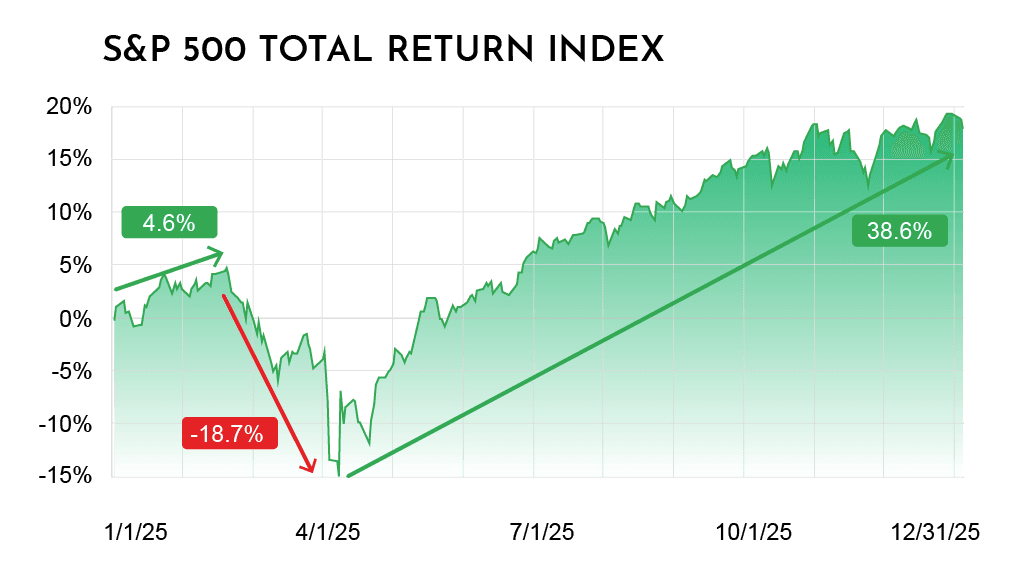
The stock market gained 17.88% in 2025.1 Volatility was a big storyline as the largest peak-to-trough drawdown was 18.7% in 2025 compared to the more tame 8.4% in 2024.1 Markets tend to not like uncertainty and we had a large amount of uncertainty due to numerous changes in policy including: immigration crackdowns, higher tariffs designed to reshape global trade balances, cuts to taxes and government spending, and many more attention-grabbing headlines than one can keep up with! Investors who embraced the uncertainty were rewarded.
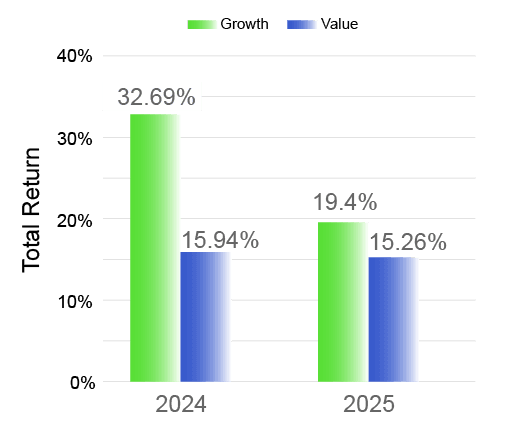
Given how much Artificial Intelligence has been in the news, one might expect the stock market’s gains were mostly due to growth-focused companies. However, there was much broader participation in 2025’s advance than there had been in 2024. Growth outperformed Value by 16.75% in 2024 but by only 4.14% in 2025.2 This was a welcome change for investors concerned about the possible over-valuation of large tech companies who sought safety in more stable industries.
Bond market gains 7% buoyed by lower rates
The bond market gained 7.3% in 2025.3 The Fed made three 0.25% cuts to the Federal Funds rate (a short-term rate) over the course of the year.4 Part of the Fed’s reasoning was based on inflation continuing to come down near its 2% target but the end of the year also saw concerns about the the lack of job creation and risks to the economy supporting “maximum employment”.5
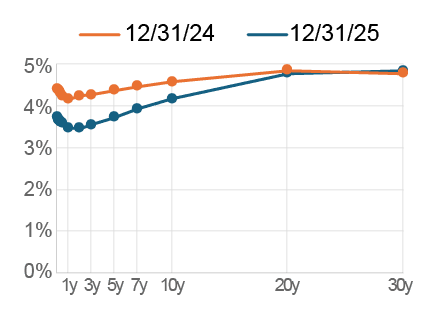
Longer-term rates which are key for things like the housing market didn’t change much in 2025. The yield curve (which shows rates for various time periods) thus steepened since lower-term rates dropped more than longer-term rates. This is a beneficial development for banks who lend at shorter-term rates and invest in longer-term rates. It also gives ongoing credence to the Fed’s aim of enabling a “soft landing” where their adjustments to monetary policy have brought inflation back into a normal range without causing a recession which an inverted yield curve (with shorter-term rates higher than some intermediate-term rates) had been signaling.7
Predictions for 2026
AI Investing will reach other sectors
We believe that business investment in AI will continue to propel markets forward in 2026. While the pace may slow, we find heart in knowing the investment is broadening out from the hyperscalers and starting to reach other sectors. There seem to be parallels to that of early Internet Search. The large players are fueling a spending war in hopes that the smaller competitors can’t keep up. Once in a dominant position, look for a transition to monetizing the products (read: ads). In the long term we expect AI to increase productivity for individuals and businesses which will lead to economic growth but it may also change the types of jobs people need to train for in the future.
More interest rate cuts expected
On the interest rate front, we expect more cuts to interest rates because inflation is stabilizing (although above target), job growth is slowing, and quite frankly because the voting members may become less independent and more politically motivated as more are appointed by the current administration.
tariff uncertainty isn’t over yet
The market is never without risks. We can’t say for sure that the tariff story is over. Many businesses stockpiled inventories before the tariffs were announced. They also passed only a fraction of the tariffs on to consumers for fear of backlash.8 That may be unsustainable and passing on more of the tariffs may start to impact consumers.
Lastly, I’ll repeat that markets don’t like uncertainty. 2026 will continue to have uncertainty as we have the midterm elections this fall and I’m sure more headlines that will surprise (like we’ve already seen with Venezuela just a few days into the new year). Our advice remains the same—keep a balanced perspective and focus on the long-term benefits of investing in a resilient and innovative U.S. economy.
Sources & Disclosures
1. Data from Kwanti.com based on the S&P 500 Total Return index
2. Data from Kwanti.com based on the Vanguard Growth ETF (VUG) and the Vanguard Value ETF (VTV)
3. Data from Kwanti.com based on the Bloomberg US Aggregate Bond Total Return index
4. https://fred.stlouisfed.org/graph/?id=DFEDTARU
5. https://www.federalreserve.gov/newsevents/pressreleases/monetary20251210a.htm#
7. https://home.treasury.gov/news/press-releases/jy2786#
8. https://www.cnn.com/2025/05/19/business/trump-tariffs-price-consumers