
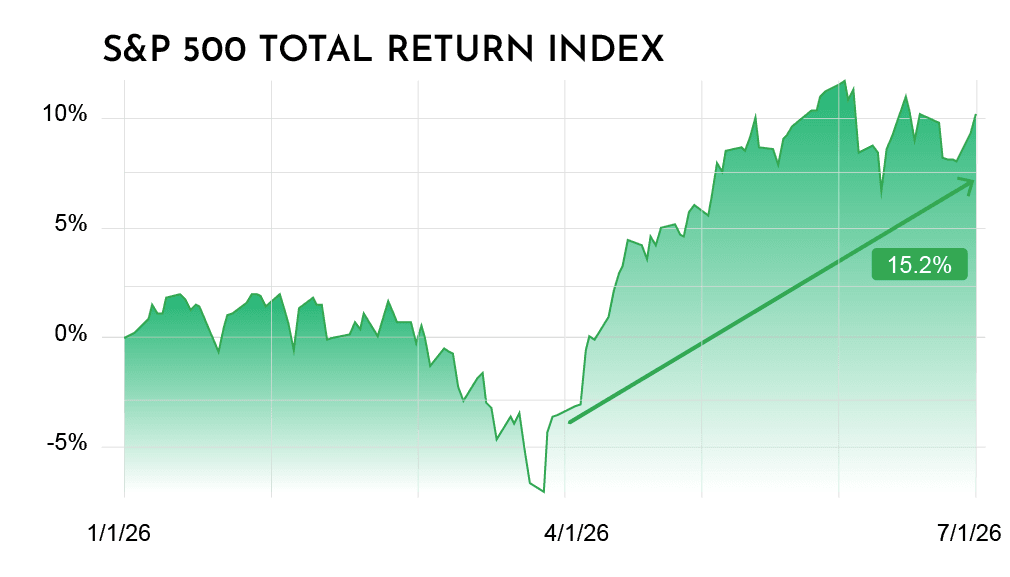
Despite the war-induced price of oil remaining high and rekindling inflation worries, the stock market found a way to have its best quarter in the last six years! Stocks were up 15.20% in the second quarter of 2026 bringing year-to-date returns to 10.21%.1 Read our Market Highlights to learn more about this and what the largest IPO in history means for your portfolio.
Stocks have best quarter in 6 years
The second quarter of 2026 had the best stock market performance of any quarter over the last six years.1 Much of this is due to a low starting value with the market low for the year happening to coincide with the start of the quarter. At the time, oil prices were driven higher by the conflict in the Middle East and the closure of the Strait of Hormuz where a significant amount of the world’s oil (and other resources) travels through. There was also uncertainty over the scope and duration of the conflict. What’s somewhat remarkable is how the market’s downward trend was reversed despite multiple iterations of failed negotiations followed by continued strikes. Instead, the market seemed to focus on earnings growth bolstered once again by the AI infrastructure trade.2 Stocks were up 15.20% in the second quarter of 2026 bringing year-to-date returns to 10.21%.1 We expect future headlines to shift to the upcoming midterm elections and how that could affect policy decisions moving forward.
Interest rates Reverse course
Bonds gained 0.67% for the quarter (0.62% for the year) as expectations have continued to shift.3 Back in January, the market was expecting two rates cuts to the Federal Funds rate over the course of 2026. After one quarter, the expectation changed to no rate cuts. Now at the half-way point, the market is pricing in nearly two rate increases.4 That’s 1.00% higher than previously expected. Much of this is due to an uptick in inflation from the sustained high price of oil arising from the closing of the Strait of Hormuz. Higher inflation along with an economy that is continuing to produce jobs (albeit a modest amount) has led the Fed to pivot toward discussing the need to raise rates to once again contain inflation as it sits above its 2% target. This is also happening as a new chair takes over the Fed. It shows that the Fed is exercising its independence (and not placating President Trump’s calls for rate cuts). That’s not to say there won’t be any changes at the Fed. It appears that under Fed Chair Kevin Warsh’s leadership the Fed may no longer provide forward guidance.5 Letting the market decide for itself could have the effect of reducing transparency and increasing volatility.
SpaceX Makes History with largest IPO
SpaceX entered the public markets through an initial public offering (IPO) that was the largest in history. The market cap of SpaceX is between Microsoft and Amazon, making it one of the five largest public companies in the world.6 While its name implies a space exploration company, its prospectus makes the case that its primary focus is AI, followed by connectivity, and then space in a distant third.
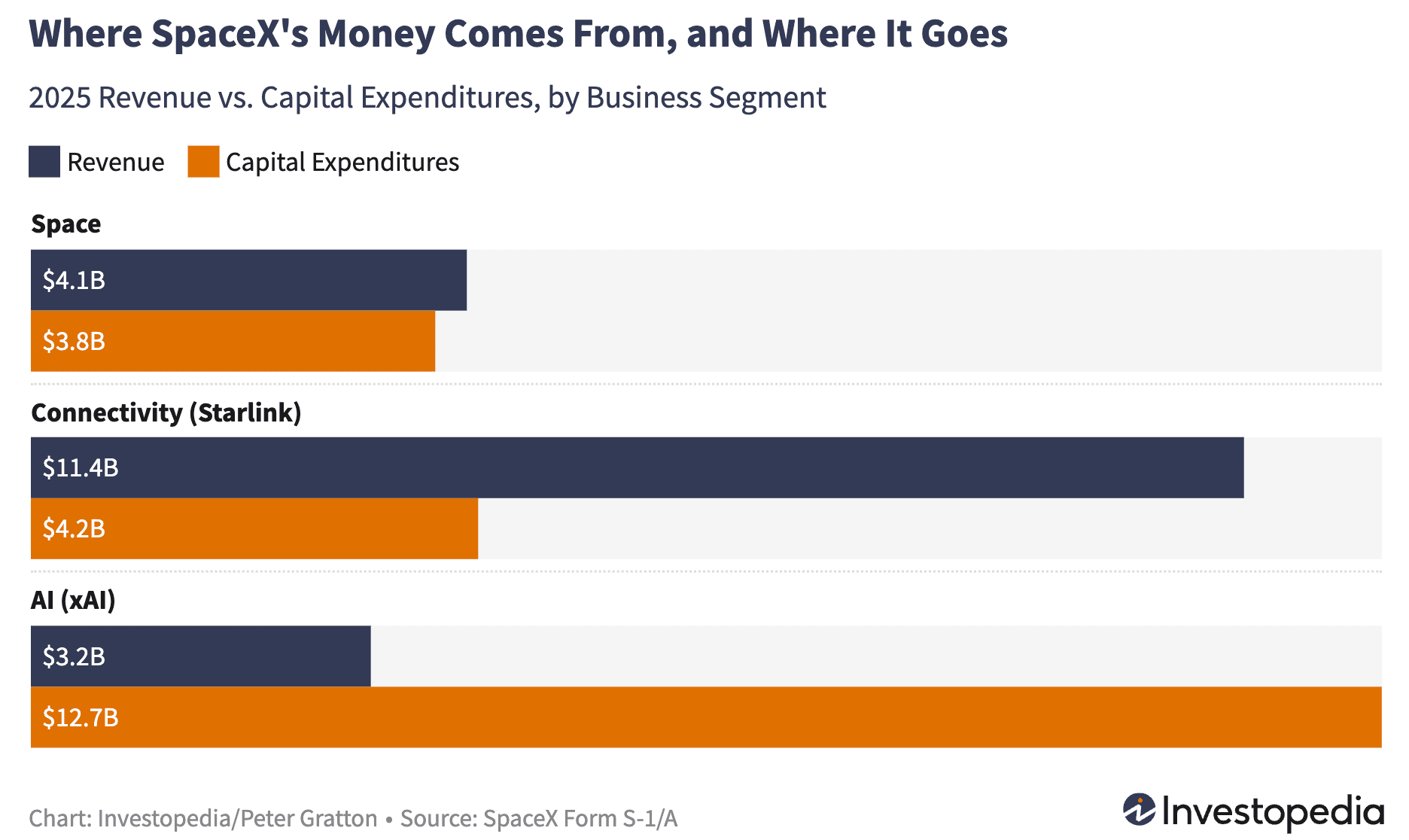
Source: investopedia.com7
This has made it very difficult to value, and analysts have pegged its per share value somewhere between $63 and $401, a huge range.8,9 After its IPO at $135, it reached as high as $225.64 in the days thereafter before plummeting 35% to $147.11 at one point.10 To be clear, many company insiders and employees are still prevented from selling their shares before the end of the blackout period which could mean there are currently more buyers than sellers.
How does the SpaceX story affect investors more broadly? For one, strong IPOs show there is positive market sentiment. Large AI companies Anthropic and OpenAI, developers of Claude and ChatGPT, respectively, also plan to IPO later in the year. Companies would jump at the opportunity to enter a market that is exuberant and setting record highs because it means the opportunity to raise more money. However, market sentiment doesn’t stay high forever, so it usually warrants caution before investor optimism changes. Secondly, SpaceX will likely be joining a fund you own in the near future. The Nasdaq 100 index (which is tracked by the Invesco QQQ ETF) changed its rules to allow SpaceX to become one of its holdings in its first 15 trading days.11 The S&P 500, meanwhile, will not adjust its inclusion rules and may not hold SpaceX for a few months. In both cases, the initial weighting may be less than expected because even though its market cap is large, the number of shares publicly available (free float) is small. This could change over time as more shares become publicly available meaning SpaceX’s impact on investor portfolios could be much greater in the future. Time will tell whether SpaceX can ultimately live up to the hype.
Sources & Disclosures
1. Data from Kwanti.com based on the S&P 500 Total Return index
2. https://abcnews.com/Business/stock-market-soar-half-2026-experts-explain/story?id=134336709
3. Data from Kwanti.com based on the Barclay’s US Aggregate Bond index
4. https://www.cmegroup.com/markets/interest-rates/cme-fedwatch-tool.html
5. https://gfmag.com/news/fed-scraps-forward-guidance-under-chair-kevin-warsh/
6. https://finance.yahoo.com/markets/stocks/articles/spacex-5th-most-valuable-public-145000682.html
8. https://www.morningstar.com/stocks/why-we-think-spacex-ipo-is-overvalued
9. https://www.aol.com/finance/veteran-analyst-sets-jaw-dropping-220300328.html
10. https://finance.yahoo.com/quote/SPCX/
11. https://finance.yahoo.com/markets/stocks/articles/spacex-ipo-reshaping-nasdaq-qqq-115200284.html
The information presented here is not a recommendation to buy or sell SpaceX, Anthropic, OpenAI, QQQ, or any other stock or fund mentioned in the article.
Integral Investment Advisors, Inc. dba Integral Wealth Management is a Registered Investment Adviser. This material is for informational and illustrative purposes only and is not intended as an offer or solicitation with respect to the purchase or sale of any security. Advisory services are only offered to clients or prospective clients where Integral Wealth Management and its representatives are properly licensed or exempt from licensure. The views and opinions expressed in this material reflects the personal opinions, viewpoints, and analyses of Integral Wealth Management employees and/or the individual providing such comments, and should not be regarded as a description of advisory services provided by our firm or performance returns of any our firm’s clients. The views and opinions expressed in this material is subject to change at any time without notice. Nothing in this material constitutes investment advice, performance data, or any recommendation that any particular security, portfolio of securities, transaction, or investment strategy is suitable for any specific person. Any mention of a particular security and related performance data is not a recommendation to buy or sell that security. Our firm manages its clients’ accounts using a variety of investment techniques and strategies, which are not necessarily discussed in the material.
This material is developed from sources believed to be providing accurate information; no warranty, expressed or implied is made regarding accuracy, completeness, legality, reliability, or usefulness of any information. Integral Wealth Management may also provide links for your convenience throughout the material to websites produced by other providers of industry-related material. Accessing websites through links directs you away from our content. Our firm is not responsible for errors or omissions in the material on third party websites, and does not necessarily approve of or endorse the information provided. Users who gain access to third party websites may be subject to copyright and other restrictions on use imposed by those providers and assume responsibility and risk from use of those websites.
It is important to note that all investing involves risk including the potential loss of principal. No investment strategy can guarantee a profit or protect against loss in periods of declining values. Past performance is not a guarantee of future results. Our firm urges you to please seek advice from your licensed financial professional prior to making any investment decision.