
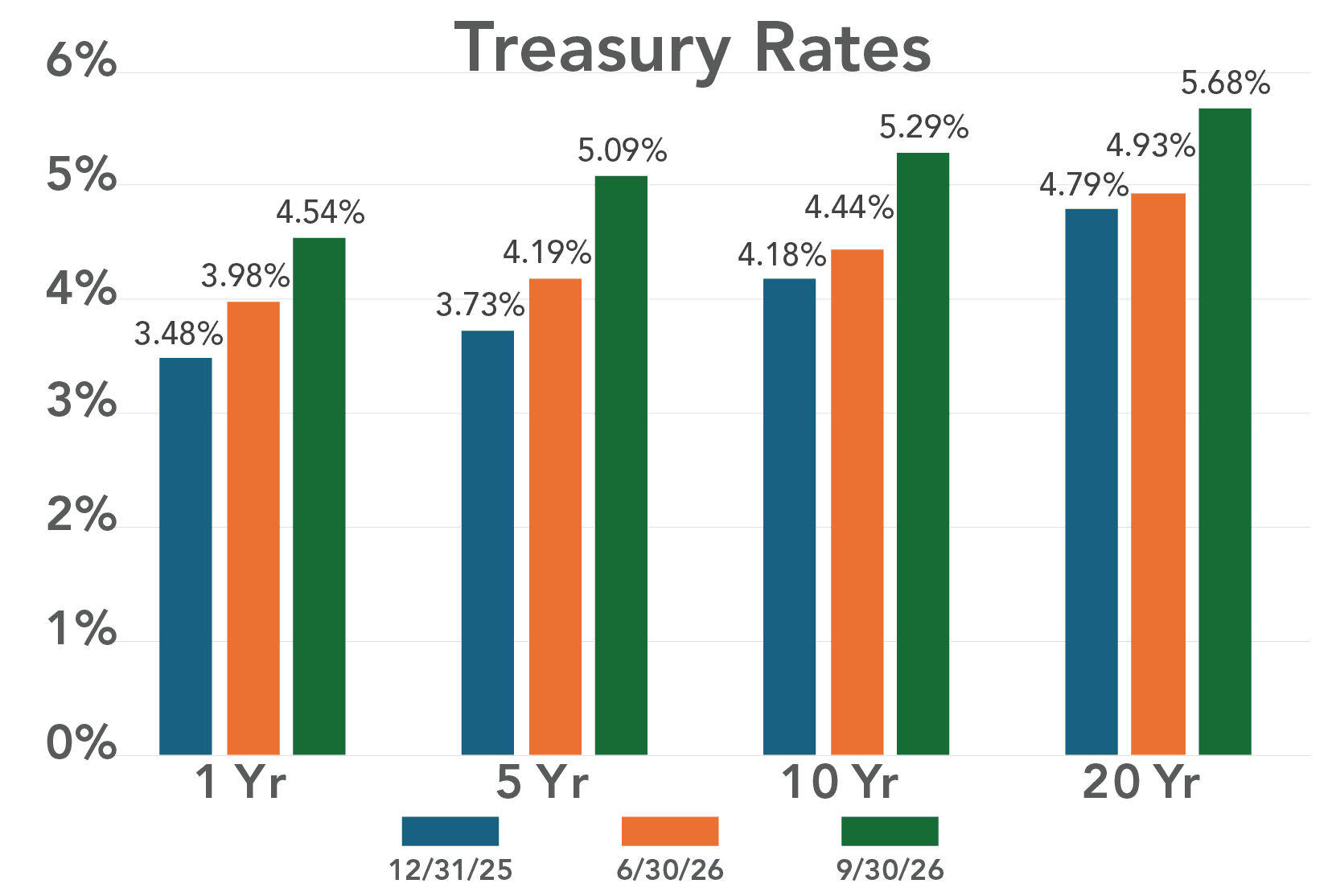
You might have missed it but the third quarter of 2026 had some big implications for portfolios. The big storyline was the rise in interest rates. The 10-year treasury rate rose 0.85% for the quarter on top of a 0.25% increase during the first half of the year. You might expect that a 1.10% rate increase would encourage a “flight to safety” and put downward pressure on the stock market due to investor rotations and/or higher borrowing costs for companies. However, the stock market continued its resilience and managed a steady 2.30% return. In light of the changing landscape and the pullback in the bond market (down 3.51% for Q3), it’s important to review portfolios, survey the opportunities, and stay disciplined.
Rising Interest Rates
Interest rates can rise for a number of factors. Higher rates could reflect higher expectations for future inflation. Sure enough, oil prices remain elevated1 due to the ongoing conflict in the Middle East and the Fed switched gears from cutting short-term rates to raising them,2 with more hikes potentially on the horizon. However, higher rates can also reflect higher expectations for economic growth, perhaps fueled by technological improvements and efficiency from artificial intelligence. Lastly, the AI buildout has also increased bond issuance3 in general, so the increased supply has required higher yields to entice more borrowers. Regardless of the reason, the increase in rates has been substantial and felt across maturities.
Analogy for Interest Rate Impact on Bonds
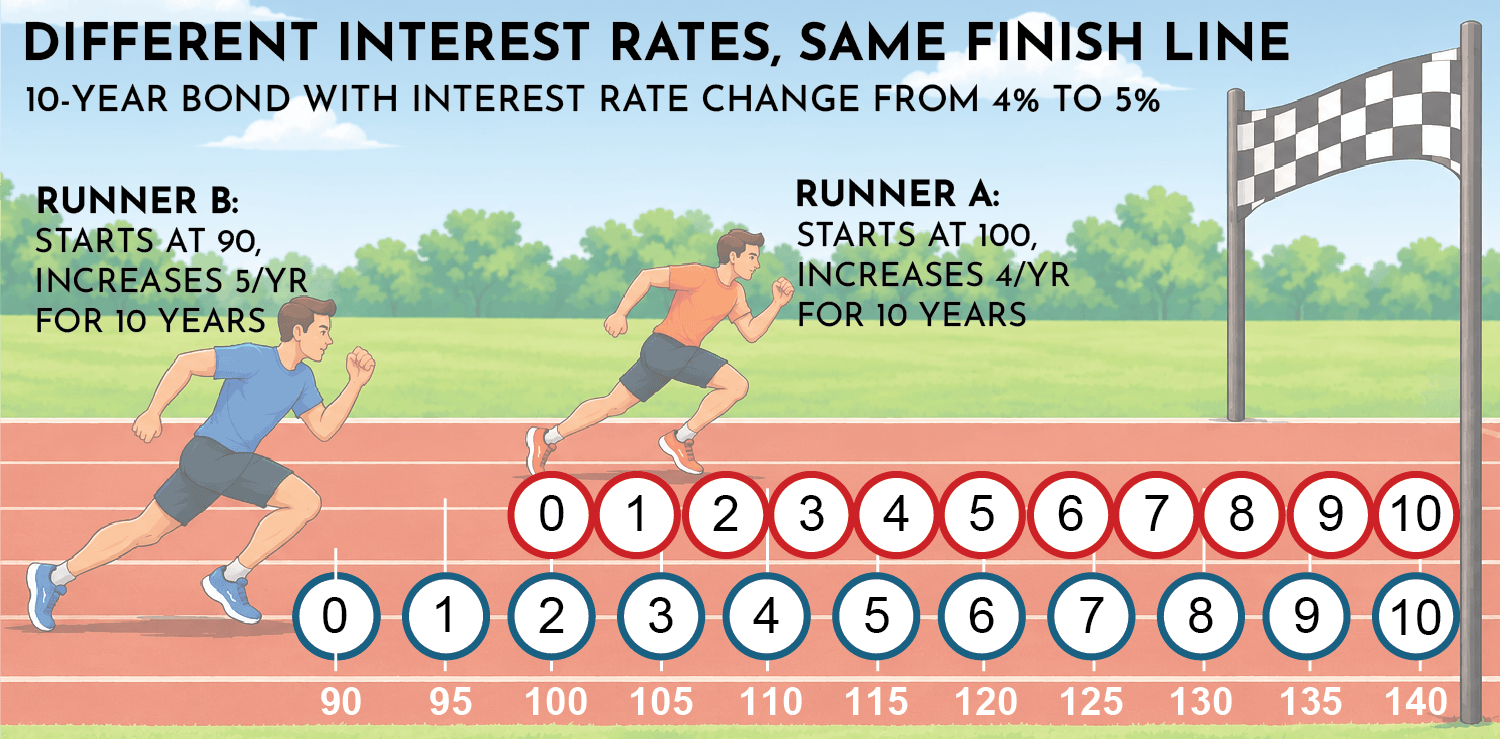
Imagine you are in a “race” where you can take 4 steps per year. In 10 years you will reach the finish line which is 40 steps away. All of a sudden, you are asked to move backwards 10 steps making the finish line 50 steps away. However, you are now allowed to take 5 steps per year. You will still end at the finish line exactly when you first expected to.
This is the case when you own a 10-year bond and interest rates change from 4% to 5%. You experience a 10% loss to the value of your bond, but you will recover that loss little-by-little (like 1% per year) in addition to earning the 4% you expected. Your total return will still be the same 4% times 10 years, but it will feel like you are temporarily moving backwards before you eventually reach the finish line.
Inversely, if interest rates drop, you will get a bit of a head start (or gain) and then take fewer steps (or experience a lower return) each year, but you will still reach the finish line when expected.
The Role of Bonds in a Portfolio
It’s important to recall the role that bonds play in a portfolio. First, they offer a safe source of investment return. This is because bonds are contractual obligations of the borrower. Coupon payments and the return of par value at maturity must happen as long as the issuer doesn’t default. Because of the known future cash flows (again, barring default) we actually can calculate the expected rate of return at the time we buy a bond.
Second, bonds provide a consistent source of income. Issuers tend to make coupon payments every six months. This predictable source of cash flow can be helpful for periodic withdrawals and/or rebalancing the portfolio.
Lastly, bond price movements tend to depend (inversely) on interest rates whereas stocks depend more on corporate earnings. Therefore, bonds and stocks often experience peaks and valleys at different times which can smooth out portfolio returns.
Despite this temporary setback in the value of bonds it is important to consider the opportunity that higher rates now present for this relatively safe asset class and how portfolios can be repositioned accordingly.
Midterm Elections
In the nearly five weeks following the end of Q3, we’ve seen rates ease up about 0.40%. That has lessened the blow felt by bond investors and supported stock prices. Essentially, the “flight to safety” alternative is less appealing than it was just five weeks ago. We’ve also witnessed the resounding “Blue Wave” during the midterm elections. Markets had a positive initial reaction to the results because a divided government is seen as reducing uncertainty by exhibiting more checks and balances.4 The following day saw companies in the AI movement fall sharply on the perception that the changing balance of power could decelerate the data center buildout.5 While we could have an interesting final quarter of 2026, it’s important to focus on the long-term benefit of staying disciplined and embracing measured levels of risk.
Sources & Disclosures
1. US Energy Information Administration crude oil prices
2. Federal Reserve – Federal Open Market Committee statement, September 16, 2026
3. US Corporate Bond Statistics (SIFMA)
4. “What does a democratic congress mean for markets?”, JP Morgan Asset Management, November 4, 2026
5. https://www.cnbc.com/2026/11/04/stock-market-today-live-updates.html
Integral Investment Advisors, Inc. dba Integral Wealth Management is a Registered Investment Adviser. This material is for informational and illustrative purposes only and is not intended as an offer or solicitation with respect to the purchase or sale of any security. Advisory services are only offered to clients or prospective clients where Integral Wealth Management and its representatives are properly licensed or exempt from licensure. The views and opinions expressed in this material reflects the personal opinions, viewpoints, and analyses of Integral Wealth Management employees and/or the individual providing such comments, and should not be regarded as a description of advisory services provided by our firm or performance returns of any our firm’s clients. The views and opinions expressed in this material is subject to change at any time without notice. Nothing in this material constitutes investment advice, performance data, or any recommendation that any particular security, portfolio of securities, transaction, or investment strategy is suitable for any specific person. Any mention of a particular security and related performance data is not a recommendation to buy or sell that security. Our firm manages its clients’ accounts using a variety of investment techniques and strategies, which are not necessarily discussed in the material.
This material is developed from sources believed to be providing accurate information; no warranty, expressed or implied is made regarding accuracy, completeness, legality, reliability, or usefulness of any information. Integral Wealth Management may also provide links for your convenience throughout the material to websites produced by other providers of industry-related material. Accessing websites through links directs you away from our content. Our firm is not responsible for errors or omissions in the material on third party websites, and does not necessarily approve of or endorse the information provided. Users who gain access to third party websites may be subject to copyright and other restrictions on use imposed by those providers and assume responsibility and risk from use of those websites.
It is important to note that all investing involves risk including the potential loss of principal. No investment strategy can guarantee a profit or protect against loss in periods of declining values. Past performance is not a guarantee of future results. Our firm urges you to please seek advice from your licensed financial professional prior to making any investment decision.